

Chronic Joint Pain & Osteoarthritis

Holistic, non-invasive treatments for chronic joint pain and osteoarthritis
Understanding Osteoarthritis
Healthy joints are protected by articular cartilage – a smooth, slightly springy tissue that covers the ends of your bones and lets them glide over one another. In osteoarthritis, this cartilage gradually thins and roughens. Your body continually tries to repair the joint, but over time that process can’t keep pace with the wear.
As the joint changes, the bone beneath the cartilage can thicken, small bony growths called osteophytes may form around the edges, and the synovium – the lining that produces your joint’s natural lubricating fluid – can become inflamed. Together, these changes cause the pain and stiffness most people recognise.
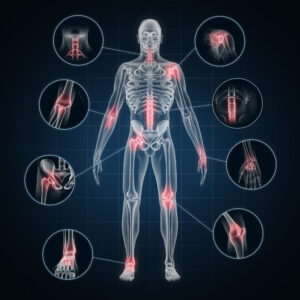
Which joints are affected?
Osteoarthritis can develop in any joint, but most commonly affects:
- Knees – the most frequently affected joint, with around 5.4 million people in the UK living with knee osteoarthritis
- Hips – affecting around 3.2 million people in the UK
- Hands – particularly the finger joints and the base of the thumb
- Spine – especially the neck and lower back
- Feet – most often the joint at the base of the big toe
Common symptoms
- Joint pain that worsens with activity and towards the end of the day
- Stiffness after rest, often easing within around 30 minutes of getting moving
- Swelling or tenderness around the joint
- A grating or crackling sensation when you move (known as crepitus)
- educed range of movement, and weakness in the surrounding muscles
Who is at risk?
Osteoarthritis is more common from your mid-40s onwards and affects more women than men. Previous joint injuries, carrying extra body weight, a family history of the condition and years of repetitive strain on a particular joint can all increase your risk.
Why joint pain becomes chronic
Osteoarthritis often becomes a cycle. Pain and inflammation make you move less; moving less weakens the muscles that support the joint; and a less supported joint takes more strain, which brings more pain. Over time, your nervous system can also become more sensitive to pain signals – a process known as central sensitisation – so discomfort can feel greater than the physical changes in the joint alone would suggest.
Breaking this cycle means addressing more than one thing at once: inflammation in the joint, the health of the tissue itself, how your body processes pain, and the wider factors that keep inflammation switched on.
Not all joint pain is osteoarthritis
Persistent joint pain can also be caused by previous injuries, overuse, or inflammatory conditions such as rheumatoid arthritis, which need different medical management. If you haven’t had a diagnosis, we’d recommend speaking to your GP first. Our treatments are designed to complement, not replace, the care you receive from your GP or specialist.
Holistic Treatments at SOMA House
Bone Density Scanning with Bindex®

Pulsed Electromagnetic Field (PEMF) therapy
Red Light Therapy
Cryotherapy
How Soma House Can Help
Each of our treatments works on a different part of the pain–inflammation–stiffness cycle. At your consultation, we’ll talk through your symptoms and history and recommend the combination best suited to you.
PEMF Therapy (Pulsed Electromagnetic Field)
PEMF therapy uses gentle, low-frequency electromagnetic pulses that pass through your skin and into the tissues beneath. Working at a cellular level, research suggests it can help calm the inflammatory signalling within the joint, support tissue repair and encourage chondrocytes – the cells responsible for maintaining cartilage – to produce collagen.
- Tissue repair: Helps boost microcirculation to the joint structures, improving the delivery of oxygen and nutrients where they’re needed.
- Pain modulation: Helps regulate how pain signals are transmitted, which may gradually raise your pain threshold.
→ Book This Treatment
Red Light & Near-Infrared Therapy
Also known as photobiomodulation, red and near-infrared light therapy uses specific wavelengths of light that are absorbed by your cells’ mitochondria – the structures that produce energy. This helps stimulate cellular repair, reduce inflammation in the joint tissue and ease discomfort.
- Cellular energy: Increases production of ATP (adenosine triphosphate, the molecule your cells use for energy) to support repair of cartilage and synovial fluid, your joint’s natural lubricant.
- Symptom relief: Helps suppress inflammatory cytokines – chemical messengers that drive swelling – improves local blood flow, and may slow nerve conduction to naturally dull pain signals.
→ Book This Treatment
Whole Body Cryotherapy
During a short session in our cryotherapy chamber, your body is exposed to extremely cold, dry air. This brief, intense cold helps interrupt pain signalling and sets off a deep physiological recovery response.
- Immediate comfort: Temporarily dampens nerve activity and relaxes muscle spasm around the joint, helping to break the stiffness cycle.
- Inflammation control: Triggers rapid vasoconstriction (narrowing of the blood vessels) to reduce joint swelling. As you warm up, a surge of oxygen-rich blood helps clear cellular waste and is associated with reduced activity of inflammatory enzymes.
→ Book This Treatment
Functional Medicine
Functional medicine looks beyond your symptoms to identify the underlying factors that may be driving cartilage breakdown and ongoing joint inflammation.
- Gut–joint axis: Addresses imbalances in your gut microbiome and increased gut permeability (often called “leaky gut”), which can contribute to whole-body inflammation.
- Targeted interventions: Identifies and reduces dietary triggers such as refined sugars, introduces anti-inflammatory nutrition and supplements, and supports the stress pathways that can heighten pain sensitivity.
→ Book a Consultation
The treatments described on this page are wellness services and are not intended to diagnose, treat, cure, or prevent any disease. Please speak to your GP or specialist about any medical condition.
